A Better Path for Communication
COMMUNICATION
7/26/20252 min read
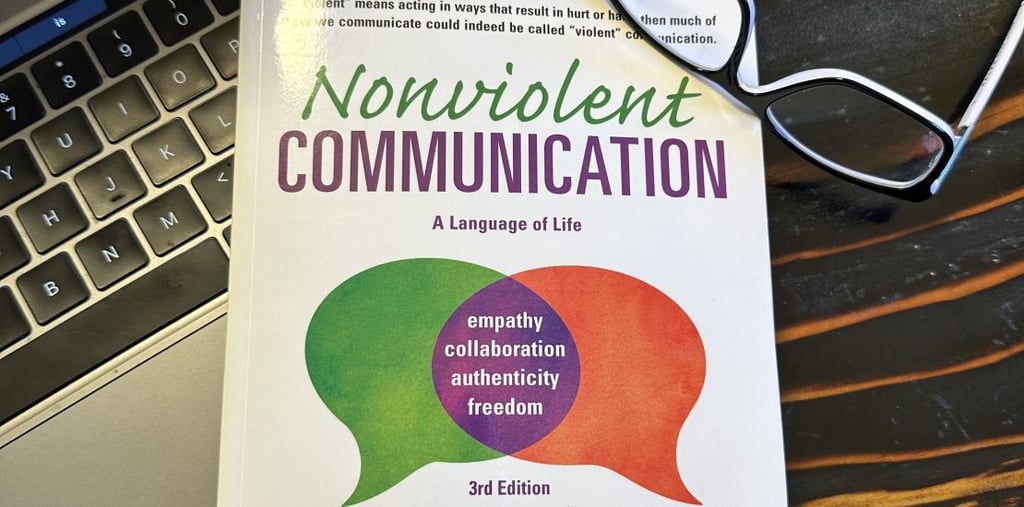
I recently picked up Nonviolent Communication by Marshall Rosenberg, and it lit up something big in my heart: the idea that even in tough moments, we can connect more deeply with others by naming our own feelings and needs — and empathizing with theirs.
Rosenberg believes that human beings always act in the service of their personal needs and values. If we can connect to our feelings and the needs behind them, we can communicate more intentionally and have those needs met. Nonviolent Communication includes four components: an observation of what we saw or heard, the feeling that resulted, the unmet need behind it, and a clear request of what we’d like from the other person. (“When I see your dirty dishes piled up in the living room, I feel irritated because I need our shared space to be more clean. Would you be willing to wash your dishes after you use them?”)
Simple in theory, right? But as soon as our emotions run hot, we tend to blame others or stew in resentment as the victim. Our culture does not effectively encourage us to reflect on our authentic needs, much less express them clearly to others. We’re accustomed instead to thinking about what’s wrong with other people. We often confuse our interpretations of someone else’s behavior with our own emotions. Saying “I feel ignored” actually describes what we think someone is doing to us. But saying “I feel lonely” reveals what’s truly going on inside us — and gives the other person something real to respond to. I also struggle — and I’m sure many women in particular can relate — to untangle my own needs from the needs of others, draining my energy by prioritizing theirs over my own.
So how can we better recognize our own needs and the needs of our colleagues and loved ones? Last night, as I was reading more of this great book, my 12-year-old daughter was seated at the other end of the couch playing The Sims. I looked on as she monitored and responded to the dashboard of her character’s needs — hunger, hygiene, social, etc. — which shrunk and became red when depleted. What if each of us had our own visible dashboard? Imagine if we could check in on our needs for autonomy, appreciation or rest just as easily — or better yet, if our coworkers could too.
While personal dashboards are still a sci-fi dream, we can learn to tune into our internal signals more often and express what we find with compassion. I’m reminded how style assessments like the Enneagram, DISC or CliftonStrengths can provide great insight into ourselves and others. Understanding your style raises awareness of your primary needs, values and motivations. When a team takes a style assessment together, it becomes a lens of understanding how best to show up for one another, and what might cause a coworker’s negative reaction. Sharing with colleagues about your style’s needs prepares the team for smoother interactions and more productive conversation when conflict does arise.
Communication will never be perfect. But we always have the power to choose how we receive and respond, and to offer empathy toward others’ needs. The principles of Nonviolent Communication invite more kindness and compassion into our daily interactions, both with ourselves and the people around us. Try pausing the next time you’re frustrated and ask: What am I feeling? What need isn’t being met? It’s a small practice with powerful potential.
Coalesce Consulting
Organizational Culture Development · Team Facilitation · Strategic Planning
© 2026 Copyright, Coalesce Consulting LLC. | Privacy Policy